46 Ave Le Sueur Interiors. Calm as a Measure of Intent
May 5, 2026
A serious residence is judged at the threshold. Before a buyer registers a finish, a fitting, or a view, they register a feeling. The interior either receives them or asks something of them. It is one of the most underappreciated disciplines in residential design, and one of the most consequential. When the interior architecture is right, the home quiets. When it is wrong, no amount of square metreage compensates.
This is the discipline that Lari Levy has spent her career refining. As founder of LCK Architects, she works at the intersection of architectural training and interior practice, and she came onto 46 Ave Le Sueur as the interior architect on a brief that was as exacting as it was restrained. The 46 Ave Le Sueur interiors were never going to be about visible authorship. They were going to be about resolution.
In any considered residential development, the interior is a quiet indicator of intent. It reveals how the team thought about life inside the building, not just the form of the building itself. At 46 Ave Le Sueur, the interiors were not approached as a decorative layer applied late in the process. They were approached as architecture that happens to be inside.
I wanted the project to feel like coming home.
That single sentence anchors most of what followed. Levy's instruction to herself, and to her studio, was that the building should not assert itself when a resident walked through the door. A home, in her view, is not the place you enter prepared. It is the place you exhale.
Translated into design decisions, that thinking produced a deliberately neutral palette, carried consistently from the basement to the penthouse. Nothing was selected to stand out. Nothing was chosen for the photograph. Materials were specified for their continuity with adjacent finishes, and the entire stack was treated as a single composition rather than a sequence of unrelated rooms. It is a quiet decision, and it is the kind of decision that shows up not in a render but in the experience of moving through the building.
The discipline beneath that calm is rigorous. Levy works from a principle most designers cite and few protect, which is that form follows function. In an environment where statement aesthetics often outrun usability, holding to that principle requires a level of restraint that is rarely visible in a finished space.
Aesthetics is secondary to how spaces work.
The 46 Ave Le Sueur interiors were tested against that hierarchy from the first sketch. How would a resident actually move through this room. Where would the morning light land. Where would the eye go on entering. Where would a piece of art sit, three years from now, when the occupant stops noticing it because it has been placed correctly. These are not glamorous questions. They are the ones that determine whether a home holds up.
What this approach yields, when it is done seriously, is a building that gets out of the resident's way. The hallways move. The proportions read. Storage is where it should be. Sightlines resolve. The sensation is one of having moved into a building that was waiting for you, not one that requires you to adapt to its preferences.
There is a separate discipline running alongside this, which is the orchestration of the design team itself. 46 Ave Le Sueur is not the work of a single studio. The architecture was led by Verv Architects. The kitchens were developed with Kalsi Davids. The interior architecture sits with LCK. The success of the building depends as much on the coordination between these practices as on any of them individually. Levy has been generous in attributing this to the developer.
Gallery Group, in her account, do not cut corners on the professional team they appoint. They commission specialists for each design discipline and resource the coordination required to keep them aligned. This is not standard practice in residential development. It is significantly more expensive, and it is significantly slower. It is also the only way to produce a building in which every detail considers every other detail, rather than competing with it.
That coordination is the invisible craft of high-end residential design. A casual observer sees the marble, the joinery, the lighting plan. What they do not see is the months of correspondence between specialists making sure that the marble in the penthouse drinks cabinet harmonises with the bronze in the mirror, that the metallic highlights in one room speak to the palette of the room beyond it, that the proportions of one element have been adjusted because of a decision taken about another. The 46 Ave Le Sueur interiors were built on that level of conversation.
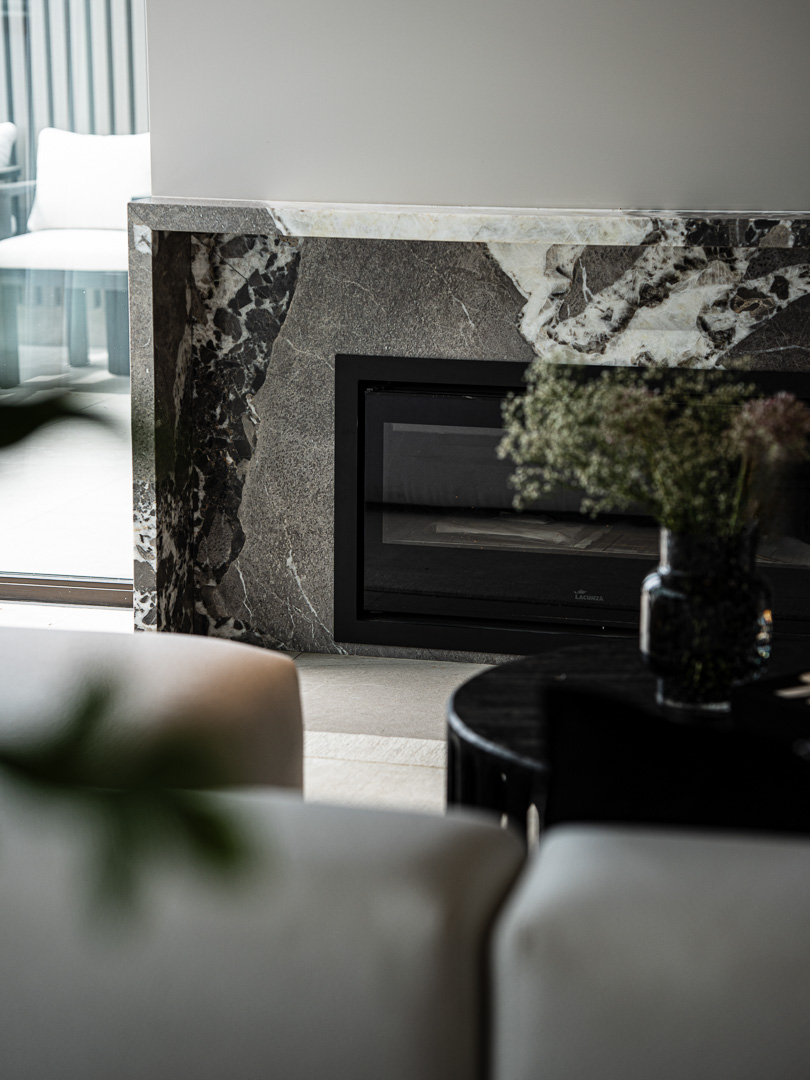
If there is a signature moment in the project, Levy will direct attention to the penthouse. The drinks cabinets and fireplaces, designed and detailed by her team, sit at the centre of the upper apartment as a quiet study in restrained luxury. A luxurious marble, paired with bronze mirror, framed by carefully chosen metallic highlights. The composition is rich, but it is not noisy. It is the kind of detail that rewards a long look, and that continues to feel correct ten years after a buyer has stopped noticing it.
That balance, between discreet luxury and lasting design, is the broader thesis of Levy's practice. She describes her work as modern classic. Bespoke enough that the resident feels the design was made for them, and disciplined enough that it will not date. It is a philosophical position more than a stylistic one. It assumes the home will be lived in for a long time, by people whose tastes will evolve, and that the work of the designer is to age gracefully alongside them.
This is not the dominant logic of the broader luxury property market. A great deal of high-end interior design is built around novelty, around the moment of impact, around the value of being striking on the first viewing. There is a place for that work, but it is not the work that survives. The interiors that endure tend to be the ones that were never trying to win the photograph in the first place. They were trying to win the morning, ten years on.
For buyers of legacy homes, this distinction matters more than any other. A residence is held for a generation, not a season. The decisions taken inside it, by the interior architect, will accumulate over thousands of small daily moments. That is the discipline 46 Ave Le Sueur was designed against, and it is the discipline that the interior architecture either honours or fails to.
The lesson Levy offers, both directly and through the work itself, is that interior architecture is a long discipline. It is not a styling exercise applied at the end of construction. It is a structural decision about how the building will be inhabited. Done with care, it produces homes that recede usefully into the lives of the people who own them.
The full Artist Series conversation embedded below offers further insight into the thinking behind the 46 Ave Le Sueur interiors and the approach Lari Levy brought to them. In understanding the interiors, one begins to understand the building.
